
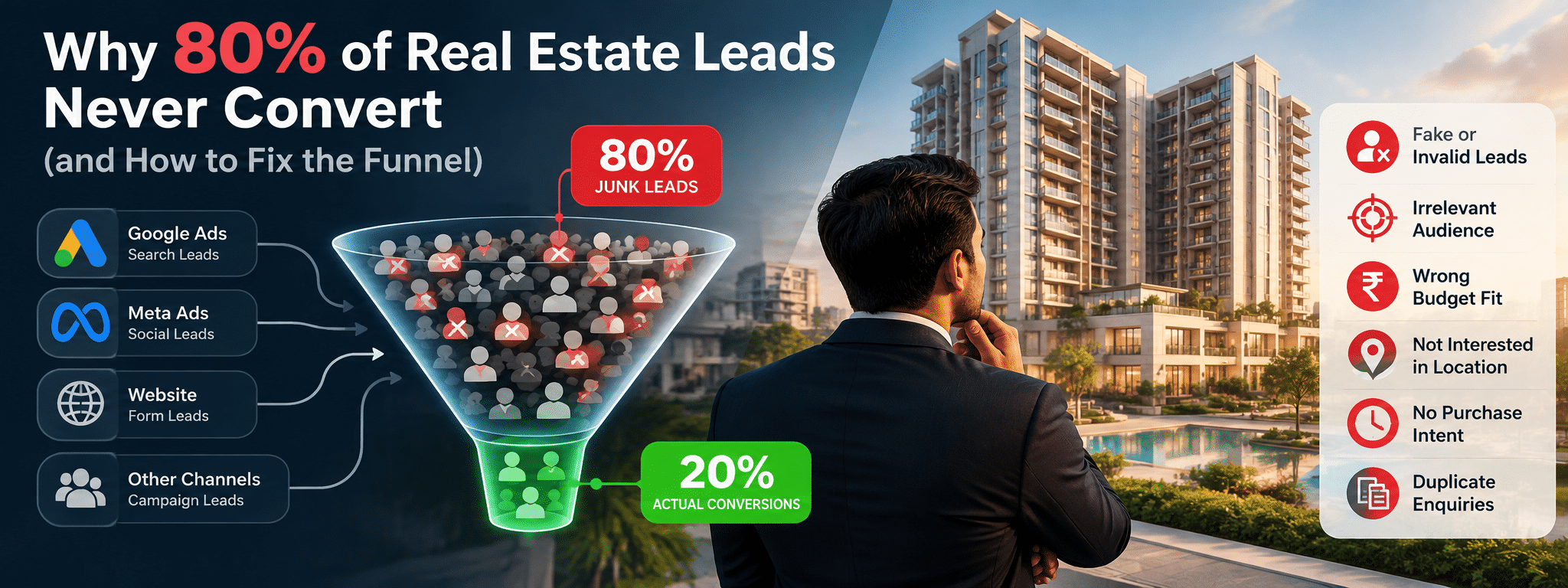
Quick Answer: Why Do Most Real Estate Leads Fail to Convert?
Real estate leads often fail to convert because advertising campaigns attract the wrong audience, forms collect low-intent enquiries, sales teams respond too late, and marketing platforms receive insufficient feedback about which leads actually become qualified prospects.
The solution is not simply to generate more leads. Developers and real estate agencies need a performance-driven funnel that combines precise audience targeting, high-intent campaigns, lead qualification questions, CRM integration, conversion tracking, and customer data from qualified and lost leads.
A specialised real estate digital agency such as Resultron.in can help developers identify where leads are dropping off, reduce irrelevant enquiries, optimise campaign spending, and improve the chances of converting advertising leads into site visits and property bookings.
The key takeaway: Measure the quality and business value of leads, not just the cost per lead (CPL).
Introduction: The Hidden Problem Behind Real Estate Lead Generation
Imagine a real estate developer spending ₹5 lakh per month on digital advertising. The campaigns generate hundreds of enquiries, and the marketing dashboard reports an attractive cost per lead.
However, the sales team discovers that many prospects have incorrect phone numbers, others are not interested in the project location, and several cannot afford the advertised property. Only a small percentage agree to visit the site.
This situation is common enough to deserve serious attention across real estate marketing campaigns. High lead volume does not automatically translate into qualified buyers, site visits, or property sales.
The title of this article uses 80% as an illustrative warning about lead leakage, not as a universal industry statistic. Actual conversion rates vary according to location, property price, project stage, audience, channel, and sales process.
For a developer, the real question is not how many leads an advertising campaign generates. It is how many relevant prospects progress through the sales funnel and what it costs to acquire each genuine sales opportunity.
Let’s explore why real estate leads fail to convert and how a structured digital marketing strategy can fix the problem.
1. Which Digital Marketing Channels Generate Real Estate Leads?
A successful real estate lead generation strategy rarely depends on a single advertising platform. Different channels serve different purposes, from capturing immediate purchase intent to building awareness among prospective property buyers.
1. Google Search Ads
Google Search Ads target users actively searching for property-related information.
Examples include:
- 2 BHK flats in Vapi
- 3 BHK flats in Andheri
- Luxury apartments in Thane
- New residential projects in Mumbai
- Property investment opportunities in Silvassa
These searches can indicate stronger purchase intent than broad interest-based audiences, although search intent must still be verified.
How to improve lead quality: Use tightly themed ad groups, location-specific keywords, negative keywords, relevant landing pages, and clear pricing or eligibility information wherever possible.
2. Meta Ads: Facebook and Instagram
Meta Ads help developers reach potential buyers based on available audience signals, interests, engagement, and campaign objectives.
Common campaign formats include:
- Instant lead forms
- Click-to-WhatsApp campaigns
- Website conversion campaigns
- Video and carousel advertisements
- Remarketing campaigns
Meta can generate substantial enquiry volume, but inexpensive instant-form leads may include people who are casually exploring property options rather than actively planning a purchase.
How to improve lead quality: Test higher-intent forms, ask relevant qualifying questions, use suitable exclusions, and optimise campaigns using downstream CRM outcomes where supported.
3. Google Display and Demand Gen Campaigns
Visual advertising can introduce residential projects to potential buyers before they begin actively searching.
These campaigns can support brand awareness, remarketing, and consideration. However, broad targeting without suitable conversion signals can attract users who are unlikely to become buyers.
Use these formats strategically, with appropriate audience controls, creative messaging, and measurable objectives.
4. Search Engine Optimisation (SEO)
SEO helps real estate brands attract organic traffic from property-related searches.
Useful content opportunities include neighbourhood guides, property price comparisons, home loan information, project comparisons, and location-specific buying guides.
For example, a developer targeting buyers in Vapi could create useful content around 2 BHK prices, infrastructure development, and the differences between residential locations.
SEO can generate sustained organic enquiries over time, although it requires consistent content development, technical optimisation, and authority building.
5. Landing Pages and Website Conversion Optimisation
A landing page is often the bridge between an advertisement and a sales enquiry.
If the page fails to communicate the project location, configuration, indicative price range, amenities, possession information, or next steps, visitors may submit accidental enquiries or leave without converting.
A strong landing page should clearly explain the offering and make the enquiry process straightforward.
6. Remarketing and CRM-Based Campaigns
Remarketing helps reconnect with eligible users who previously interacted with a website or advertisement.
CRM-based audiences can also help advertisers reach relevant existing prospects or build audiences based on qualified leads, subject to platform eligibility and applicable consent requirements.
These campaigns are particularly useful when a property purchase involves multiple visits, family discussions, financing decisions, and a longer consideration period.
2. Why Do Real Estate Campaigns Generate Junk Leads?
Junk leads are enquiries that are invalid, irrelevant, duplicated, uncontactable, or unlikely to match the property’s intended buyer profile.
Not every lead that fails to book a site visit is a junk lead. Some prospects need additional time, are waiting for loan approval, or may purchase later. Correctly classifying these outcomes is essential.
Here are the major reasons poor-quality leads enter the funnel.
Broad and Irrelevant Audience Targeting
Campaigns targeting an entire city may reach people who live far from the project, cannot afford the property, or have no interest in moving to the area.
For example, promoting a premium apartment in Thane to a broad audience without considering location relevance or realistic affordability can generate many enquiries but few sales opportunities.
Optimising for Cheap Leads Instead of Qualified Prospects
When campaigns are evaluated primarily on cost per lead, advertising algorithms may prioritise people likely to complete a form rather than people likely to buy a property.
A ₹100 lead is not necessarily better than a ₹500 lead if the cheaper lead has a much lower probability of converting.
Low-Intent Lead Forms
Short forms can make it easy for users to enquire without carefully considering the project.
For example, a form that requests only a name and phone number may produce more submissions but provide little information about budget, configuration preference, purchase timeline, or location requirements.
Misleading Advertising Creatives
Advertisements that omit important information or make exaggerated promises may attract attention from people who are not suitable buyers.
Clear communication about property type, location, indicative pricing, and eligibility can help set appropriate expectations.
Fake, Duplicate, and Incorrect Contact Details
Some submissions contain incorrect phone numbers, duplicate records, or contact information that does not belong to a genuine prospect.
Verification methods, duplicate detection, and CRM validation can reduce the impact of these records.
Slow Sales Follow-Up
Even a qualified lead can lose interest if the sales team takes too long to respond.
Marketing and sales teams should agree on response-time expectations, lead assignment rules, follow-up schedules, and a consistent process for recording every contact attempt.
3. How Junk Leads Waste Real Estate Advertising Budgets
When a campaign generates many irrelevant enquiries, the financial impact extends beyond the advertising cost of each form submission.
Consider this illustrative example.
A developer spends ₹5,00,000 per month and receives 1,000 leads at an average cost of ₹500 per lead. If 800 leads turn out to be invalid or unsuitable, only 200 remain potentially relevant.
In this example, 80% of the leads are unsuitable. That does not mean 80% of the total advertising spend is automatically wasted: some spending also contributes to brand awareness, audience learning, and future demand. However, the cost of acquiring and processing those unsuitable enquiries can be substantial.
The table below illustrates the direct advertising cost associated with the different lead categories.
| Metric | Illustrative result |
| Monthly advertising spend | ₹5,00,000 |
| Total leads generated | 1,000 |
| Average cost per lead | ₹500 |
| Invalid or unsuitable leads | 800 |
| Potentially relevant leads | 200 |
| Advertising cost associated with unsuitable leads | ₹4,00,000 |
| Advertising cost associated with remaining leads | ₹1,00,000 |
These figures are hypothetical and assume the same average advertising cost across all leads. They are not an industry benchmark.
The developer may also incur additional expenses through call-centre salaries, sales team time, CRM operations, and repeated follow-up attempts.
A campaign that looks successful in the advertising dashboard may therefore perform poorly at the business level.
The solution is to shift from volume-based optimisation to quality-based optimisation. Track qualified leads, site visits, bookings, and acquisition costs alongside traditional advertising metrics.
4. How to Prevent Junk Leads from Google Ads and Meta Ads
One of the most important improvements in real estate digital marketing is closing the feedback loop between advertising platforms and the actual sales funnel.
Google and Meta initially receive signals from the actions they can observe, such as clicks, form submissions, or website conversions. If advertisers report only these early-stage actions, the platforms may have limited information about which prospects become qualified buyers.
CRM integration and offline conversion tracking can help solve this problem.
Step 1: Classify Leads Properly in Your CRM
Create clear stages for every enquiry:
- New lead
- Contact attempted
- Contacted successfully
- Qualified lead
- Site visit scheduled
- Site visit completed
- Negotiation
- Booking completed
- Lost or disqualified
Record reasons for disqualification wherever possible, such as an incorrect number, unsuitable budget, wrong location, duplicate enquiry, or no purchase intent.
Do not classify every unresponsive prospect as permanently disqualified after one missed call. Use a defined follow-up process before assigning a final status.
Step 2: Upload Qualified Lead Data to Google & Meta Ads
Google & Meta Ads supports offline conversion measurement and enhanced conversions for leads in eligible configurations.
With appropriate implementation, a developer can connect CRM outcomes to advertising interactions using supported identifiers and matching methods.
For example, when a prospect becomes a qualified lead or completes a site visit, the corresponding conversion event can be imported into Google & Meta Ads.
This allows the advertiser to measure which campaigns, keywords, and audience strategies contribute to meaningful sales outcomes rather than merely generating forms.
Where sufficient data and campaign compatibility exist, value-based bidding or qualified-lead conversion goals may help improve performance.
Important: Do not count every CRM stage as an equivalent primary conversion. Select meaningful goals, configure conversion values carefully, and avoid double-counting the same outcome.
Step 3: Share Qualified and Lost Lead Signals with Meta & Google
Meta & Google offers supported CRM integrations and Conversions API workflows that can help advertisers send eligible conversion events back to the platform.
For example, a real estate developer may send events representing qualified leads, completed site visits, or purchases, depending on the integration and campaign objective.
These events can provide additional information about the outcomes that matter to the business.
However, uploading a list of lost leads does not automatically prevent similar people from submitting forms. Its usefulness depends on how the data is used.
Potential applications include:
- Excluding eligible existing leads from prospecting where appropriate.
- Creating permitted custom audiences from relevant customer records.
- Building lookalike audiences from qualified customers, where available and appropriate.
- Measuring the quality of leads generated by different campaigns.
- Sending downstream conversion events to support optimisation.
A list of lost leads should not be treated as a single, universal exclusion audience. Lost leads may include people who were unqualified, those who purchased elsewhere, and prospects who simply postponed their decision. Each category requires a different strategy.
Step 4: Use Separate Audiences for Qualified Leads and Lost Leads
Customer data becomes more useful when it is segmented by outcome.
For example:
Qualified leads: Use eligible data to understand the characteristics of valuable prospects and develop relevant acquisition or remarketing strategies.
Completed site visits: Measure which campaigns generate prospects willing to take the next step.
Booked customers: Where appropriate, use customer audiences for suppression, retention, referrals, or analysis of successful acquisition sources.
Disqualified leads: Analyse the reasons for failure. Use supported exclusions where appropriate, and refine the campaign’s targeting, messaging, and qualification process.
For Google & Meta Ads, customer lists and data segments have specific eligibility, consent, and policy requirements. For Meta, Custom Audiences and related features are also subject to eligibility and policy restrictions.
Neither platform guarantees that every uploaded record will match or that audience exclusions will eliminate all similar enquiries.
Step 5: Optimise for Meaningful Conversion Events
Once reliable conversion data is available, evaluate whether campaigns should optimise towards qualified leads or another meaningful downstream event rather than raw form submissions.
A practical progression is:
- Ensure tracking and CRM data are accurate.
- Record qualified and disqualified outcomes consistently.
- Import or send supported conversion events.
- Verify event matching and attribution.
- Review lead quality by campaign, ad group, keyword, placement, and audience.
- Test optimisation strategies once sufficient reliable data is available.
Do not switch optimisation goals blindly. Campaigns need suitable conversion volume, correct tracking, and a compatible bidding strategy.
Step 6: Improve Forms, Landing Pages, and Follow-Up
Platform data is only one part of the solution.
Ask relevant questions about budget range, preferred configuration, buying timeline, and location requirements. Keep forms concise enough to avoid unnecessary friction.
Use OTP verification when justified by the cost of invalid submissions, but test its impact on both lead validity and conversion volume.
Review placements and exclude unsuitable inventory when the data supports doing so. Monitor lead quality by placement rather than assuming that every placement in a particular network is poor.
Finally, establish a structured sales follow-up process so that qualified prospects receive timely, relevant communication.
5. How to Measure Real Estate Lead Quality Beyond CPL
A real estate marketing dashboard should show the complete funnel rather than stopping at the number of enquiries generated.
Important metrics include:
Cost per lead (CPL): Total advertising spend divided by leads generated.
Lead validity rate: The percentage of leads with valid contact details and usable enquiry information.
Lead qualification rate: The percentage of leads that meet agreed qualification criteria.
Cost per qualified lead (CPQL): Advertising spend divided by qualified leads, with the reporting methodology clearly defined.
Site visit rate: The percentage of leads that complete a site visit.
Booking conversion rate: The percentage of leads or qualified opportunities that result in bookings, using a consistent denominator.
Cost per booking: Advertising spend divided by attributable bookings, taking attribution limitations into account.
For example, a campaign generating leads at ₹300 CPL may appear better than one generating leads at ₹700 CPL. But if the first campaign produces very few qualified prospects while the second generates more site visits and bookings, the higher-CPL campaign may be the stronger investment.
The objective is to reduce the cost of acquiring a genuine sales opportunity, not simply to minimise the cost of collecting contact details.
6. Why Hire a Specialist Real Estate Digital Agency Like Resultron?
Real estate advertising involves longer buying cycles, location-specific demand, high-value transactions, and close coordination between marketing and sales.
A specialist real estate digital agency can help connect campaign performance with actual business outcomes.
Resultron.in offers digital marketing and lead generation services for real estate businesses. When evaluating an agency, developers should look for the following capabilities.
Performance-Driven Campaign Management
A suitable agency should understand how to structure Google Ads and Meta Ads campaigns around project locations, property configurations, buyer intent, and business objectives.
Lead Quality Analysis
Campaign reporting should go beyond clicks, impressions, and CPL. It should identify which sources generate valid enquiries, qualified prospects, site visits, and bookings.
CRM and Conversion Tracking Integration
An agency should be able to plan and implement appropriate conversion tracking, coordinate CRM integrations, and help feed supported offline conversion signals back to advertising platforms.
Audience and Funnel Optimisation
The right partner should test landing pages, lead forms, audience segments, remarketing strategies, and campaign objectives using evidence rather than assumptions.
Transparent Reporting
Developers should receive clear reports explaining what is working, what is underperforming, why lead quality changes, and which corrective actions are recommended.
Continuous Improvement
No campaign strategy can eliminate every junk lead. The objective is to reduce avoidable waste through ongoing testing, accurate data, and collaboration between marketing and sales teams.
If your campaigns are generating a large volume of enquiries but very few genuine buyers, consider discussing your lead generation funnel with Resultron.in.
Conclusion: Stop Buying Leads and Start Building a Qualified Sales Funnel
Real estate lead generation is not successful simply because an advertising campaign generates hundreds of enquiries. Success depends on attracting the right prospects, qualifying their requirements, engaging them at the right time, and measuring how they progress towards a purchase.
The most effective approach combines high-intent Google Search campaigns, carefully managed Meta advertising, useful landing pages, CRM-based qualification, offline conversion tracking, and a disciplined sales follow-up process.
Sharing eligible qualified-lead and lost-lead signals with advertising platforms can improve measurement and, when configured correctly, help campaign optimisation focus on more meaningful outcomes. It must be supported by accurate data, appropriate consent, platform compliance, and sufficient conversion signals.
For developers and property marketers, the next step is clear: audit your funnel, identify where unsuitable leads enter, and optimise campaigns for qualified prospects and business results.
Want to improve the quality of your real estate leads? Visit Resultron.in to explore digital marketing and lead generation services for real estate brands.
Frequently Asked Questions (FAQs)
1. Why do most real estate leads fail to convert?
Common reasons include broad targeting, low-intent forms, incorrect contact details, unsuitable budgets, misleading advertisements, slow follow-up, and limited coordination between marketing and sales. The exact reasons vary by project and campaign.
2. Is it true that 80% of real estate leads are junk leads?
No universal industry-wide figure establishes that 80% of real estate leads are junk. The percentage in this article is illustrative. Developers should calculate their own invalid and unqualified lead rates using CRM data.
3. Which digital marketing channel is best for real estate lead generation?
Google Search Ads can capture active search demand, Meta Ads can reach and engage prospective buyers, SEO can attract organic traffic, and remarketing can support longer buying journeys. The best channel depends on the project, target audience, location, and budget.
4. How can I reduce junk leads from Meta Ads?
Use appropriate audience targeting, clear advertising messages, higher-intent forms, relevant qualification questions, duplicate detection, and CRM-based outcome tracking. Test placements and campaign objectives using qualified-lead data rather than assumptions.
5. How can Google Ads generate better-quality property leads?
Use relevant keywords, negative keywords, location-specific targeting, informative landing pages, clear pricing information where appropriate, and accurate conversion tracking. Import eligible offline conversions to measure outcomes beyond form submissions.
6. Can uploading lost leads to Google Ads reduce junk leads?
Not automatically. Eligible customer data can support permitted audience exclusions, customer matching, and analysis, depending on the campaign and product. Better lead quality also requires improved targeting, qualification, and conversion measurement.
7. Can qualified-lead data improve Meta Ads performance?
It can help provide additional conversion signals when sent through supported integrations, such as an eligible CRM and Conversions API workflow. Results depend on data quality, event matching, campaign setup, and the volume of reliable conversion events.
8. Should real estate developers use OTP verification on lead forms?
OTP verification can reduce fake or incorrect phone numbers, but it may also reduce form completion. Test it against lead validity, qualification rates, and cost per qualified lead before applying it to every campaign.
9. What is the difference between CPL and cost per qualified lead?
CPL measures advertising cost per submitted lead. Cost per qualified lead measures advertising cost per lead that meets predefined qualification criteria. The second metric is often more useful when evaluating the commercial quality of real estate campaigns.
10. How does CRM integration help real estate digital marketing?
CRM integration connects advertising enquiries with sales outcomes. It helps marketing teams identify which campaigns produce qualified leads, completed site visits, and bookings, and can support the return of eligible conversion events to advertising platforms.
11. How often should real estate campaigns be optimised?
Review campaign performance regularly, including lead quality and sales feedback. Avoid making major changes based on small samples or short-term fluctuations. Optimisation frequency should reflect campaign spend, conversion volume, sales-cycle length, and the time needed for meaningful outcomes.
12. Why should a developer hire a real estate digital agency?
A specialist agency can help with campaign strategy, audience targeting, lead qualification, conversion tracking, CRM integration, performance reporting, and continuous testing. Choose a partner based on its processes, transparency, technical capabilities, and measurable results rather than promises of guaranteed bookings.
13. What is the most important metric for real estate lead generation?
There is no single metric for every business. Cost per qualified lead, completed site visits, booking conversion rate, and cost per booking together provide a more complete picture than CPL alone.
14. How can Resultron help improve real estate lead generation?
Resultron can be considered for digital marketing and lead generation support, including campaign management and funnel improvement. Developers should discuss their current campaign data, CRM setup, lead qualification process, and conversion goals to determine the most appropriate engagement.
Are your Google Ads and Meta Ads generating enquiries but not enough site visits or bookings? Connect with Resultron.in to explore ways to improve your real estate marketing funnel and lead quality.