
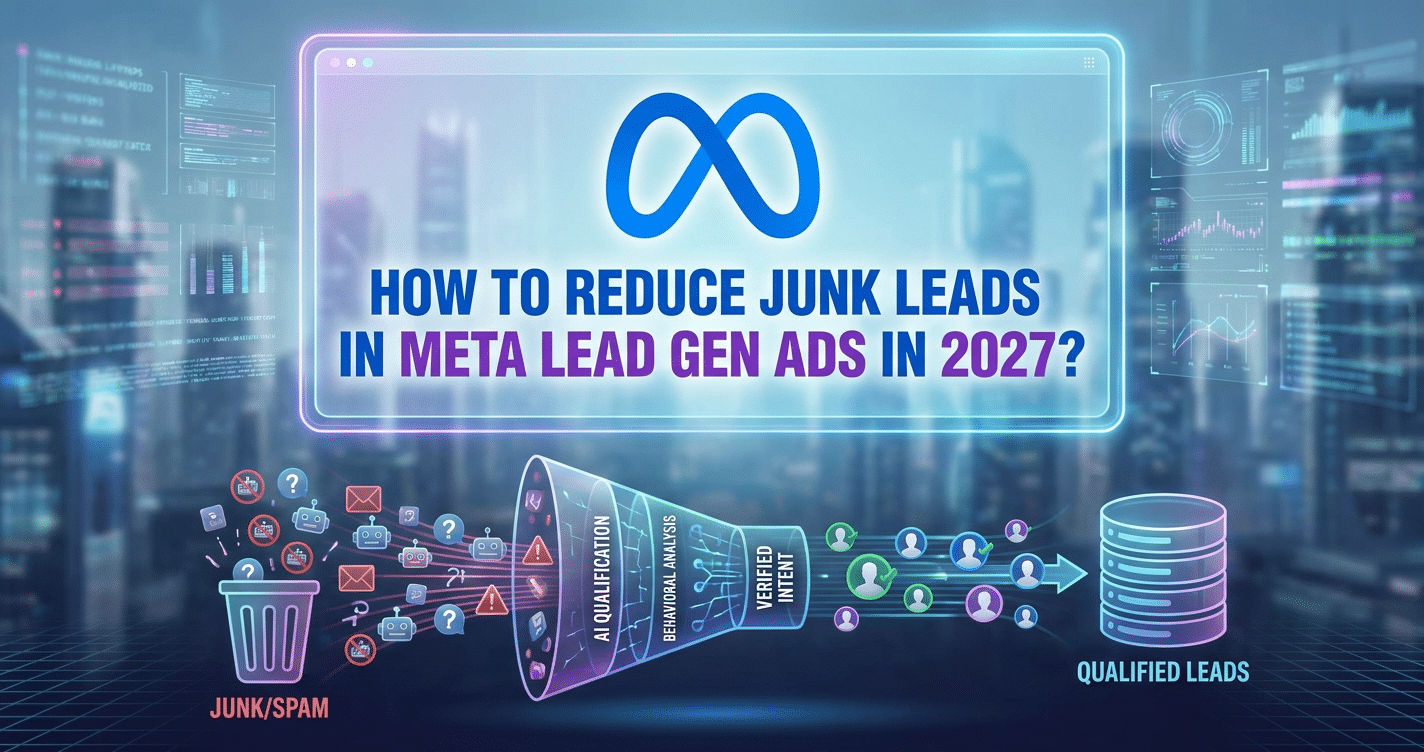
Quick answer: To reduce junk leads from Meta lead generation campaigns in 2027, focus on lead quality instead of lead volume. Use OTP-verified forms, three qualification questions, conditional questions, clear ad messaging, tighter audience signals, location exclusions, placement analysis, and CRM-based lead-quality feedback. A low-cost lead is not necessarily a valuable lead.
Important: 2027-specific Meta features and campaign settings may change. The recommendations below are based on current Meta advertising practices and Google Search guidance available in 2026. Review the latest Meta Ads Manager options before implementing a campaign.
Meta remains an important channel for businesses that need a steady flow of enquiries. It can work particularly well for real estate, education, finance, healthcare, automotive, travel and local services.
However, many advertisers face the same problem: the campaign generates leads, but sales teams receive irrelevant, duplicate, incomplete or unreachable enquiries.
The solution is not simply to increase the advertising budget.
The better approach is to build a lead-generation system that gives Meta stronger signals about the people who are actually valuable to the business.
Why Meta Ads Are Essential for Lead Generation
Meta Ads can help businesses reach potential customers while they are browsing Facebook and Instagram.
Businesses can use different campaign approaches depending on the desired action. These can include lead forms, website conversions, messaging-based campaigns and other conversion-focused campaigns.
Meta’s advertising ecosystem also provides multiple placements across its platforms. For example, Reels is integrated with Meta’s broader placement system and can be used to reach audiences through immersive mobile experiences. Facebook
For advertisers, the main advantage is the ability to combine:
- Audience targeting
- Creative testing
- Lead forms
- Website landing pages
- Messaging
- Retargeting
- Conversion tracking
- CRM feedback
The objective should not be “How many leads can I generate?”
Instead, ask:
“How many sales-qualified leads can I generate at an acceptable cost?”
That change in measurement can completely alter campaign optimization.
Types of Meta Lead Generation Campaigns
There is no single lead-generation setup that works for every business.
1. Instant Form Lead Campaigns
Meta Instant Forms allow prospects to submit their information without leaving the Meta environment.
These campaigns can generate a large volume of enquiries because the user journey is relatively short.
They can be useful when speed and mobile convenience are important.
The challenge is that a short form can also make it easy for low-intent users to submit their details.
2. Website Lead Generation Campaigns
Instead of collecting information directly through an instant form, the advertisement sends users to a website or landing page.
The visitor can then complete a detailed enquiry form.
This adds another step to the journey.
That additional friction can sometimes help filter casual users.
The landing page should clearly explain:
- What the customer is enquiring about
- Location
- Starting price or price range, where appropriate
- Key benefits
- Eligibility
- Expected response
- Next step
3. Click-to-Message Campaigns
Businesses can also use Meta advertising to start conversations.
Depending on the setup, users may communicate through supported messaging channels.
This approach can be useful when the sales process requires discussion before qualification.
However, the conversation should have a structured qualification process.
4. Conversion-Focused Campaigns
Businesses with sufficient website and CRM data can optimize campaigns around deeper conversion events.
For example:
Lead → Qualified Lead → Site Visit → Opportunity → Sale
This is more useful than optimizing only for raw form submissions.
Meta’s advertising ecosystem uses signals from user actions and advertiser-selected objectives. Meta’s own Audience Network material also distinguishes advertiser outcomes such as conversions from simple impressions. Facebook
Why Do Meta Ads Generate Junk Leads?
Junk leads can happen for several reasons.
It is rarely caused by one setting alone.
1. The Form Is Too Easy
If someone can submit a form after entering minimal information, the barrier to conversion is very low.
That can increase volume.
It can also increase irrelevant submissions.
2. The Advertisement Is Too Broad
A generic advertisement can attract people who do not understand the actual offer.
For example:
“Get Your Dream Home Today!”
This sounds attractive.
But it does not communicate price, location, configuration or eligibility.
A more specific message could mention:
“2 & 3 BHK homes in Thane from ₹X*.”
The objective is to make the advertisement self-qualifying.
3. Audience Signals Are Too Broad
A campaign can reach users outside the practical customer profile.
Location, age, interests, customer lists and other available campaign controls should therefore be reviewed based on the business and Meta’s current targeting capabilities.
4. Poor Placement Performance
Different placements can generate different types of interactions.
Do not judge placements only by CPL.
Review:
- Leads
- Qualified leads
- Cost per qualified lead
- Contact rate
- Appointment rate
- Sales opportunity rate
Meta’s own advertising materials emphasize testing variables and measuring performance rather than assuming one placement will work universally. Facebook
5. Optimizing Only for Cheap Leads
This is one of the biggest problems.
Suppose:
Campaign A
100 leads × ₹200 CPL = ₹20,000
But only 5 are qualified.
Campaign B
50 leads × ₹400 CPL = ₹20,000
But 20 are qualified.
Campaign B produces fewer leads.
Yet its sales team may have significantly more useful opportunities.
Therefore, CPL should not be the only KPI.
How to Optimize Meta Lead Gen Ads for Better Lead Quality
1. Add OTP Verification
OTP verification can add an additional layer of validation to the lead-generation process.
For example:
Name → Mobile Number → OTP → Qualification Questions → Submit
This can help reduce:
- Fake numbers
- Incorrect numbers
- Accidental submissions
- Low-quality contact information
OTP verification should be implemented in a privacy-conscious way and with clear consent messaging.
It is also important to remember that OTP verification does not automatically prove buying intent.
It verifies the contact detail.
The qualification process determines intent.
2. Add Three Customized Qualification Questions
Instead of asking only:
Name
Phone
Email
add questions relevant to the business.
For a real estate campaign, for example:
Question 1: Which configuration are you looking for?
- 1 BHK
- 2 BHK
- 3 BHK
- Other
Question 2: What is your approximate budget?
- ₹50–75 lakh
- ₹75 lakh–₹1 crore
- ₹1–1.5 crore
- ₹1.5 crore+
Question 3: When are you planning to purchase?
- Immediately
- Within 3 months
- 3–6 months
- Researching
These questions provide useful context to the sales team.
They also create additional friction for people who are simply clicking advertisements.
3. Use Conditional Questions
Conditional questions can make qualification more relevant.
For example:
Are you looking for a property for investment or self-use?
If the person selects Investment, ask:
What is your approximate investment budget?
If the person selects Self-use, ask:
Which configuration are you looking for?
This creates a more meaningful lead profile.
The exact conditional-form functionality available to advertisers can change as Meta updates its products, so confirm the current options inside Ads Manager before deployment.
4. Make the Ad Copy More Specific
Your advertisement should pre-qualify the user before they submit the form.
Include information such as:
- Location
- Product
- Price range
- Configuration
- Eligibility
- Offer
- Key differentiator
For example:
Weak:
Find your dream home today. Enquire now!
More specific:
Looking for a 2 or 3 BHK in Thane? Explore homes near Teen Hath Naka. Check pricing, floor plans and possession details.
The second version gives the user more information before the click.
That can reduce curiosity-driven enquiries.
5. Optimize Placements Using Lead Quality
Do not automatically remove placements based only on CPL.
Instead, evaluate placement-level lead quality.
Create a report such as:
| Placement | Leads | Qualified Leads | CPL | Cost/Qualified Lead |
| Facebook Feed | 150 | 45 | ₹250 | ₹833 |
| Instagram Feed | 100 | 35 | ₹280 | ₹800 |
| Reels | 200 | 20 | ₹180 | ₹1,800 |
| Other placements | 120 | 12 | ₹220 | ₹2,200 |
This gives a very different picture from a simple CPL report.
The important metric becomes:
Cost per Qualified Lead
rather than:
Cost per Lead
Meta’s advertising materials emphasize testing and measuring individual variables because performance can differ by placement and creative. Facebook
6. Review Audience Quality
Audience strategy should reflect the actual customer.
Depending on the campaign, consider testing:
- First-party customer audiences
- Website visitors
- Engaged users
- Qualified-lead audiences
- Customer lists
- Lookalike or similar audience approaches where available
- Relevant broad audiences
- Retargeting audiences
The most important point is to provide Meta with better conversion signals.
If Meta receives only the signal:
Lead submitted
it may optimize toward people likely to submit forms.
If the system receives meaningful downstream signals, the optimization strategy can become more aligned with business outcomes, subject to the campaign setup and available Meta features.
7. Exclude Irrelevant Locations
Location mistakes can create a large number of unusable leads.
For a local business, clearly define the serviceable geography.
For example, a campaign for a Mumbai property should not automatically target every location simply because the product might theoretically interest people elsewhere.
Review:
- City
- State
- Serviceable radius
- Nearby locations
- Excluded locations
- Existing customers
- Areas that repeatedly generate irrelevant leads
Location strategy should be based on actual sales data.
8. Use Negative Qualification Signals
Qualification questions should not only identify good prospects.
They can also identify poor-fit prospects.
For example:
What is your budget?
If the minimum product price is ₹1 crore, someone selecting a budget of ₹25 lakh may not be sales-ready.
The business can then decide how that lead should be handled.
It might enter a nurture campaign rather than immediately reaching the sales team.
9. Connect Meta Leads With Your CRM
Lead quality becomes much easier to measure when Meta data is connected with the sales process.
Track the complete journey:
Ad → Lead → Contacted → Qualified → Appointment → Opportunity → Sale
Then calculate:
- Cost per lead
- Contact rate
- Qualification rate
- Appointment rate
- Opportunity rate
- Cost per qualified lead
- Cost per appointment
- Cost per opportunity
- Revenue generated
This creates a feedback loop between advertising and sales.
10. Build a Junk Lead Feedback Loop
Every lead should receive a status.
For example:
Lead Status
- New
- Contacted
- Qualified
- Not Interested
- Wrong Number
- Duplicate
- Invalid
- Budget Mismatch
- Location Mismatch
- Appointment Booked
- Converted
After several weeks, analyze the data.
You may discover that most junk leads come from:
- A particular placement
- A particular audience
- A particular location
- A particular creative
- A particular age segment
- A particular campaign
- A particular form
Then optimize the source rather than manually rejecting leads one by one.
A Practical Meta Lead Quality Framework for 2027
A strong lead-generation campaign can follow this structure:
Step 1: Define the ideal customer.
↓
Step 2: Create specific advertising messaging.
↓
Step 3: Select relevant audiences and locations.
↓
Step 4: Use an appropriate lead-generation method.
↓
Step 5: Add OTP verification where appropriate.
↓
Step 6: Add three qualification questions.
↓
Step 7: Use conditional questions where useful.
↓
Step 8: Review placement-level quality.
↓
Step 9: Connect leads with CRM.
↓
Step 10: Feed qualified-lead outcomes back into optimization.
This approach changes the campaign from lead generation into lead-quality optimization.
Common Mistakes to Avoid
Mistake 1: Optimizing Only for CPL
A cheap lead can still be commercially useless.
Mistake 2: Using Generic Ad Copy
Users may submit forms without understanding the offer.
Mistake 3: Asking No Qualification Questions
This removes an important opportunity to filter intent.
Mistake 4: Removing Placements Without Testing
A placement with a higher CPL may still produce better qualified leads.
Mistake 5: Ignoring Sales Feedback
Marketing data should connect with actual sales outcomes.
Mistake 6: Using Excessive Form Friction
Too many questions can reduce legitimate conversions.
The goal is controlled qualification, not making the form unnecessarily difficult.
FAQs About Reducing Junk Leads From Meta Ads
1. How can I reduce junk leads in Meta Lead Ads?
Use specific ad messaging, OTP verification, qualification questions, conditional questions, audience refinement, location exclusions and CRM-based lead-quality tracking.
2. Does OTP verification reduce fake leads?
OTP verification can help validate the submitted phone number. It does not guarantee that the person has genuine purchase intent.
3. How many questions should a Meta lead form have?
There is no universal number. Three well-designed qualification questions can be a useful starting point. Test the impact on both lead volume and quality.
4. Should I use custom questions in Meta Lead Ads?
Yes, when qualification is important. Questions should identify characteristics that matter to your sales process.
5. Why are my Meta leads cheap but poor quality?
Your campaign may be optimized toward inexpensive form submissions rather than meaningful downstream outcomes. Audience, messaging, placement and form design can also contribute.
6. Should I disable Meta Audience Network?
Do not make that decision solely from CPL. Compare placements using qualified-lead and downstream sales metrics before changing your placement strategy.
7. How do I improve real estate leads from Meta Ads?
Mention the property location, configuration, pricing or price range, possession details and eligibility in the advertisement. Then use qualification questions for budget, configuration and purchase timeline.
8. What is more important, CPL or cost per qualified lead?
For sales-driven campaigns, cost per qualified lead provides more useful information than CPL alone.
9. Can CRM data improve Meta lead campaigns?
CRM data can help businesses understand which leads become qualified opportunities or customers. Where Meta supports the required integrations and optimization signals, downstream outcomes can be incorporated into campaign measurement and optimization.
10. Can an agency manage Meta lead-generation campaigns?
Yes. An experienced performance marketing agency can manage campaign structure, creatives, forms, audiences, placements, tracking, lead qualification and reporting.